Be yourself; Everyone else is already taken.
— Oscar Wilde.
This is the first post on my new blog. I’m just getting this new blog going, so stay tuned for more. Subscribe below to get notified when I post new updates.
Be yourself; Everyone else is already taken.
— Oscar Wilde.
This is the first post on my new blog. I’m just getting this new blog going, so stay tuned for more. Subscribe below to get notified when I post new updates.

For the most part, I don’t think I am a good writer. I don’t think I am a terrible writer, either. I think I can string coherent sentences together which, whilst readable, are ultimately unextraordinary. But I was reading some of my papers the other day and other pieces I’ve done, and I felt a bit of pride for what I had created. I’m my own worst judge, but I actually thought some of it was good.
I loved all the novels and topics we covered such as dystopian societies, literacy narratives, and rhetorical analysis. I have to say my rhetorical analysis essay was my strongest paper I’ve written overall this class, I really enjoyed studying and observing bits and pieces a film and relating it to how it left readers and how the rhetoric was a significant peace in the whole film. I can really say that I have a better understanding of rhetoric and its importance, it really taught me how powerful words and visuals in other aspects are to delivering and presenting a message or situation to your readers and audience.
I have taken a few English classes at Chapman University and I have to say looking back ever since freshman year I could really say I haven’t proved to an extent. I still have a lot of work to do in terms of writing and reading which I’m very excited to continue for my future. I really also enjoyed the free writes, 1984, and Maus I.
Throughout all the writing assignments I have done throughout the semester I found the major papers, the reading questions, and the blog assignments very helpful and improving my writing. My favorite free right was how I was feeling about Covid-19 because it was my first time opening my laptop and expressing how I felt from such a drastic change. Another favorite major paper of mine was the literacy narrative it was nice to express how I felt from a third person point of view which was quite interesting for me. overall I really enjoyed this class and I believe a lot of change has come out of my writing do to it, I will take what I have learned throughout the semester and guided with me throughout my future endeavors and experiences!

Controversy Surrounding Vaccination
Humans have benefited from immunization for more than two centuries. At face value, this is considered both as one of the greatest achievements of humankind and in public health. Despite the success story of vaccination, there is much controversy regarding the use and vaccine safety. This has led to the resurgence of vaccine hesitancy where more and more skeptic anti-vaxxers have decided against vaccinating either themselves or their children based on unfounded claims about vaccine safety (Smith, 2017). This has intensified tension throughout communities, particularly as immunization detractors began used to certain set assumptions on vaccines such as they are against Christian beliefs, and that giving children multiple vaccinations for a host of diseases can overload their immune systems.
Dear Anti-Vaxxers,
I am writing to you with much concern after it came to my realization that your uneducated decision against vaccines might be putting your children at a health risk. By sharing this information means that I care about you and your children. While I have attempted to dig deeper and hear both sides in the immunization fight, all I can find is scientific information that expresses support for vaccination and uneducated opinion that is grounded in unsubstantiated evidence. A clear majority of you base your decision against vaccination on misconceptions about vaccine safety. For example, there is widespread fear amongst you that immunization increases the risk of autism. This claim originated from a man whose hypothesis has since been completely discredited and his medical license revoked (Robinson, 2020). Some could find it hard to believe, so it might help to tell you that a well-designed scientific study provides evidence that children present with the symptoms of autism well before they get MMR vaccine to protect against the three viruses, including mumps, measles, and rubella.
Because of fear that you keep fanning conservative estimates ow show that measles that was eradicated a few decades ago has seen a rise in a new measles outbreak. As a consequence, this has led the World Health Organization (WHO) to raise a red flag that there might have been more cases of measles in 2019 than in any other year (Robinson, 2020).
It is mainly for his reason that I am writing to you today, to officially tell that accepting a parent’s decision not to vaccinate is something I have a hard time doing. Parents bear the responsibility for making the best decision for their children (Branswell et al.,2018). While they have the desecration to choose whether to have their children vaccinated despite heath experts’ objections, what about their rights to grow up without risk and fear of disease? What will you think as a parent when your daughter develops rubella during pregnancy and delivers a child with congenital deafness? What will your son think of your decision when he is rendered infertile and cannot get children due to orchitis that was caused by infection with mumps virus at childhood?
I am sure you will that because of vaccination, these conditions are lot less common nowadays. Smallpox has since been wholly eradicated while polio led the world to see frightening outcomes of vaccine-preventable disease, now only a few cases are reported in a few isolated pockets in less developed countries. Also, you may be surprised to hear that as of 2017, vaccine-derived polio led to a dramatic reduction in the prevalence of the disease, with only 22 reported cases (Branswell, 2017). At this point, efforts are underway to eliminate the disease. Thanks to the efforts aimed at prevention and management of the once fatal condition called bacterial meningitis. Today, advances in the development of three vaccines have paid off as there has been a dramatic reduction in the incidence of this deadly disease. There is a long list of conditions that have been eradicated by the vaccine, and this has saved millions of lives across the globe.
You may be interested to learn that among the number studies that have been conducted to determine the safety of vaccines. None has determined that multiple vaccines can overload an infant immune system (Fetter, 2017). For one thing, your child’s immune system is stronger than you think. According to the number of foreign substances that children get exposed to, health experts state that the small fraction of virus or bacteria contained in vaccines is not strong enough to cause any harm to your child. What can be harmful is taking away a child’s right to vaccination.
On this understanding, I am sure that you now realize as parents that you have the responsibility to make a decision that will lead to the vaccination of your children. It should naturally come to your realization that you are not making the decision for your child but for every child with whom your child comes into contact.
In making the vaccination choice as parents, you must first consider your children’s future. How will they reflect on the past and judge the decision that you made for them in the most vulnerable years? Through your research, you will realize there are many options to turn to for the facts about the vaccine. While still at it, please try to understand both sides of the vaccine debate. If you are going to judge both perspectives fairly, it is essential to ask yourself where you can as a parent turn for the scientifically proven facts about vaccine safety? One of the ways is to consult your trusted healthcare provider.
I am not going to belittle you, but relying on anecdotal evidence about the safety of vaccines is the same as making a decision not to act. As responsible citizens, you should be aware that you must use vaccines to minimize suffering and death from preventable diseases. The CDC recommends most of these vaccines.
On that note, how about challenging your biases? Did you call into question the sources of your information? To be clear, the health of your children depends on it. So, instead of endangering your communities and your children, the best approach is to make a well-informed decision and vaccinate your child. It is worth conducting background research as this is the only way you will place value on information provided by scientific proof, and guidance from health experts cannot be ignored.
I am sure if the display of religious zealotry continues, a disease like measles can shift and mutate into new strands. The discovery of these strands can be a massive blow to the already existing vaccine. For this reason alone, the consequences could be dire such that the new strains may put everyone out there at risk until another vaccine is developed. Both national and independent laboratories usually do testing, and standards stipulate that this must be maintained. Considering vaccine development is a long and complicated process, no one knows how long that could take.
In conclusion, thank you for taking the time to listen to views and beliefs expressed in this letter. It is hoped that it will make you start taking your child’s vaccine decision seriously. I assume you love your children more than anything in the world. I also believe that we can all agree that the fear of endangering someone you love is one of the few things that will make you anti-vaxxers change your outlook.
“Be a Lady They Said” is a feminist video that has recently gone viral. The video is intense, and it deals with the unnecessary social sexist pressures women face every day. American actress Cynthia Nixon discusses the phrases and comments that women listen to and put up with daily about how they must be and about how they must behave to fit into society. The primary purpose of this video is to have the face of an influential activist call out the ridiculous expectations women deal with when it comes to beauty, their bodies, and behavior. In this video, it calls out the impossible standards women are told to aspire to, and how often those standards contradict each other. In this short film, it leaves behind such a shocking and robust feeling with the viewer; through its intense rhetorical devices, images, and tone of voice– it will have you question what it is to be a woman.
This video is alarmingly powerful and reveals the overwhelming pressures that come with being a woman. The narration is combined with grim, menacing music and images from advertisements, movies, TV, and photographs from Girls Girls Girls magazine. It also features Rachel McAdams’s famous magazine cover wearing a breast pump. This video is essential, compelling, and worth the watch mainly because watching it will force you to think. The narrative tone is matter-of-fact and everything that is said contradicts one another. Later I will be analyzing the rhetorical devices that were used that stood out to me the most. Such as: anaphoras, persuasion, enumerations, repetition, rhetorical questions, etc.
The condescending tone behind “Just be a lady” makes it seem as though being a “lady” is simple, that standards are easy to uphold if you just conform to society’s demands. Standards are easy to uphold if you just conform to society’s demands. Personally, I find the word “Lady” belittling. Typically when someone says, “Be a lady,” they mean to be polite, look presentable, and keep quiet. I say screw that. Be loud, be strong, wear what you want, do what you love, embrace your sexuality, nurture your body. This video is alarmingly powerful and reveals the overwhelming pressures that come with being a woman. The narration is combined with grim, menacing music and images from advertisements, movies, TV, and photographs from Girls Girls Girls magazine. It also features Rachel McAdams’s famous magazine cover wearing a breast pump. This video is significant, compelling, and worth the watch primarily because watching it will force you to think.
I believe the target audience that the author is addressing is mainly women who are struggling in society to confine themselves to extreme norms to “be a lady.” Another target audience is the media (such as magazines, advertisements, movies, etc.) The audience will affect the author’s initial argument because the author is trying to voice how the media plays a crucial role in the stress women endeavor of having to act like a proper lady. Women specifically affect the author’s initial argument because she is trying to make aware of the phrases and comments that women listen to and put up with daily about how they must be and how they must behave to fit into society well. In essence, women can learn not to listen to those words and to be beautiful in their own skin.
The narrator uses a particular tone of voice when delivering this poem. As well as the alarming pictures to show the harsh conditions women are forced to do and how they need to behave. The poem has very contradicting sentences such as using words like do not do this and do not do that, but do this. Furthermore, the ‘this’ part contradicts the don’ts. The poem was describing all the ridiculous expectations women everywhere deal with when it comes to beauty, their bodies, and their behaviors. Using repetitive words and always pausing and saying “be a lady they said,” really impacts the reader and how the message resonates with them afterward.
Suffocating judgments on a top and skirt being ‘too short’ are clamped with forcing a lady to be ‘sexy,’ but not provocative. With lines conveying that ‘men have needs’ and ‘men cannot resist themselves,’ a woman is stripped of her own personal choices. This kaleidoscopic video venture jumps into food habits, and each sentence is its former’s contradiction. A trap is weaved rapidly, and the listener’s thought of a solution is smothered by the next obligation. ‘Eat up,’ ‘slim down,’ ‘order a salad,’ ‘you look like a skeleton,’ and ‘men like women with some meat on their bones’ come rapidly – and the audience gets no chance to think for itself. It is thus a very apt portrayal of the ways the society can press down on a lady, offering no escape, no peace.
Some rhetorical devices used in “Be a Lady They Said,” is anaphora, enumeration, simile, persuasion, pathos, logos, and ethos. An anaphora is when a specific word or phrase is repeated at the beginning of clauses or sentences that follow each other; for example: “don’t,” “cover,” “wear,” and “be.” An enumeration is used to detail how to be a lady for a man properly: which entailed, “remove your body hair, bleach this, bleach that, eradicate your scars, cover your stretch marks, plump your lips, botox your wrinkles, lift your face, tuck your tummy, perk up your boobs…” A simile is used to insult or depreciate a women’s esteem. When the narrator says: “you look like you’ve let yourself go,” and “God, you look like a skeleton.”
‘Be a size zero, be a double zero, be nothing, be less than nothing,’ is one of the strongest sentences in this video, complete with an ECG machine’s continuous beep in the background. It also focuses on the pressures the society supposes it is at liberty to exert on women. The commercialization of Botox, ‘tucking the tummy,’ removal of bodily hair, plumping lips, removing stretch marks, and scars are forced alongside the compulsion to look natural. It is said that men do not like women who try too hard now, do they? It becomes the society it condemns, forces you to ‘feel’ by stealing each emotion, and asks you to be a human by letting go of each drop of humanity.
One of the most powerful tips on being persuasive in a rhetorical piece is making the audience feel. In this video, it leaves you with a shocking and silent view on how women are forced to live up to these ‘perfect’ standards. Rhetoric is the study and art of writing and speaking well, being persuasive, and knowing how to compose successful writing and presentations. In the video “Be a Lady They Said,” it prompts the viewers to invest emotionally and personally into the topic of women and captures their attention to acknowledge them about the crucial standards.
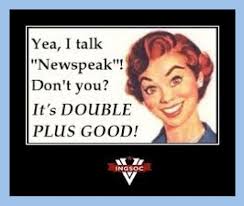
“Newspeak” is an attempt by Big Brother to control thought by reducing the number of words in the language and eliminating words that might lead to “thoughtcrime,” which is itself a Newspeak word. Is it possible to control thought through controlling language? Does our own society have similar tendencies? Discuss examples of Newspeak in the novel and how this kind of control might function in our society (Source: https://textrhet.com/2017/09/13/new-1984-writing-prompts/).
Most people probably recall two very memorable features of Nineteen Eighty-Four. The first one, undoubtedly, is the mantra of Big Brother and his ever watchful eye. The other is the language Orwell created specifically for the world of his famous dystopian: Newspeak. The purpose of Newspeak is to reduce the meaning of language, thus antonyms, synonyms, and so on are obsolete and an unnecessary part of language.
Orwell thought that Totalitarian societies and specially the one portrayed in the novel wanted to turn humans into machines, to replace the organic by the inorganic, to create synthetic happiness by eradicating all that may evoke natural passions and personal inclinations. This is basically what is about 1984; but what is important here is the way they achieve so, the way they get to control people. They make use of plenty of techniques such as control of information and history, psychological manipulation, physical control, technology, etc, but the ones I’m going to deal with in depth in my blog are those related to mind control, the ways in which they manipulate people’s minds.
Orwell believed that totalitarianism and the corruption of language were connected. He focused especially on political language where you distorted events and concepts by calling them something else. You said things in such a way that you avoided producing an inner picture of them. As an example, he said that ‘If thoughts can corrupt language, language can also corrupt thoughts. This idea would eventually lead to Newspeak.’
One of Orwell’s most important messages in 1984 is that language is of central importance to human thought because it structures and limits the ideas that individuals are capable of formulating and expressing. If control of language was centralized in a political agency, Orwell proposes, such an agency could possibly alter the very structure of language to make it impossible to even conceive of disobedient or rebellious thoughts, because there would be no words with which to think them. This idea manifests itself in the language of Newspeak, which the Party has introduced to replace English. The Party is constantly refining and perfecting Newspeak, with the ultimate goal that no one will be capable of conceptualizing anything that might question the Party’s absolute power.
When it is necessary to manipulate with history and your own memory it is equally necessary to forget that you have done so. This is accomplished with a mental technique, which in Oldspeak was called reality-control and in Newspeak is called doublethink:“To know and not to know, to be conscious of complete truthfulness while telling carefully constructed lies, to hold simultaneously two opinions which cancelled out, knowing them to contradictory and believing in both of them, to use logic against logic, to repudiate morality while laying claim to it, to believe that democracy was impossible and that the Party was the guardian of democracy, to forget whatever it was necessary to forget, then draw it back into memory again at the moment when it was needed, and then promptly to forget it again: and above all, to apply the same process to the process itself. That was the ultimate subtlety: consciously to induce unconsciousness, and then, once again, to become unconscious of the act of hypnosis you had just performed. Even to understand the word ‘doublethink’ involved the use of doublethink.” [NEF pp. 31-2]
The purpose of Newspeak is not only to be a medium for the ideas and worldview of Ingsoc; it is also meant to make all other ways of thinking impossible and thus remove all heretical thoughts.Charges of Newspeak are sometimes advanced when a group tries to replace a word/phrase that is politically unsuitable (e.g. “civilian casualties”) or offensive (e.g. “murder”) with a politically correct or inoffensive one (e.g. “collateral damage”). Some maintain that to make certain words or phrases ‘unspeakable’ (thoughtcrime), restricts what ideas may be held (Newspeak) and is therefore tantamount to censorship. Others believe that expunging terms that have fallen out of favour or become insulting will make people less likely to hold outdated or offensive views. The intent to alter the minds of the public through changes made to language illustrates Newspeak perfectly.As the Party’s mind-control techniques break down an individual’s capacity for independent thought, it becomes possible for that individual to believe anything that the Party tells them, even while possessing information that runs counter to what they are being told.
Newspeak was created by the totalitarian overlords of Oceania, with its fictional leader known as Big Brother, in order to actually limit free thought and free speech. In totalitarian governments, those in charge try to control every aspect of citizens’ lives, even down to personal habits.Newspeak is important because it contains no words that could be used for thoughtcrimes, therefore anyone who uses it can’t commit a thoughtcrime because they won’t know the words. It is ironic because while most languages increase in size, Newspeak decreases in size justifying how the party wants total control over the people. It goes without saying that language shapes our thoughts. But can it be used to manipulate and control our minds like it was in the grim world of 1984? Unfortunately, the answer is a very clear yes.In our society today, I believe there are a few factors that might control how humans behave and act. Our own society does have similar tendencies such as technology and the government. In 1984, language is of central importance to human thought because it structures and limits the ideas that individuals are capable of formulating and expressing. And it correlates to society today because us humans are so focused on the news, articles, reading, and social media that we are very careful on how we act online versus in person.
Literacy Narrative: By Nadeen Amoudi
She was forced to read when she was hiding from her mother. It was around the year 2003, she was about four years old and escaped as usual to the upstairs library. She adored that library in her first home, with its tall rectangular shaped window doors, and how the balcony overlooked the french-inspired looking garden with its large fountain surrounded by six skyrocket juniper trees. The sun would blaze through the trees near the windows and would hit the wood floors making it the perfect place to read because the wood was so warm. The library had a musky smell inside, with dark brown wood covering the floors and shelves, and the camel-colored leather couch that you could tell had a lot of history and character from four kids over the years. Then when her mother would come home, she would retreat upstairs.
When her mother would come home around five in the afternoon slurring her words and smelling of whiskey…she could sense it wasn’t really her mom at the time so she would go upstairs. She would always grab a chair and lean it under the door handles in the library because there was never a lock on the door. This would happen pretty often and she slowly grew to spend more time in the library room… until her father had to tell her it was time for bed.
Her mother reeked. And her father would always give her a look to go up to her safe space. It was then when she picked up one of the first books she could actually read Picky Mrs. Pickle. She never really understood or cared more to learn more about her mother’s problem or how it was affecting her household— so she blurred it out since it started. That book and that blockage of surroundings striked in her a drive to start reading and escaping in these books as a different character, a character that wasn’t herself.
Slowly she grew fonder and fonder of becoming a new character even if it was just for a few hours a day. The older she got the she became more engrossed in books such as: I am Malala, The Strange Case of Dr.Jekyll and Mr.Hyde, The Catcher in the Rye, Lord of the Flies, and The Outsiders. It was as if she was no longer a girl from Miami with a messed-up home life. She was instead Malala from Pakistani activist, or Dr.Jekyll a well-respected and intelligent scientist who meddles with the darker side of science, or as Ponyboy Curtis who gradually loses his innocence and matures overtime.
She continued reading.
Perhaps she started to read because it was the one thing that distracted her at the time. But as time passed and she got older, she started to have a bit more of an understanding of what her mother did to herself and why her parents split. What her mother was doing was toxic to herself and her mental state. Her presence affected the room and tore her family into nothing but confusion and veiling the pain. Around this time is when she began to journal or write on her laptop in times of pain or frustration.
She matured very quickly without her mother in the family picture, she was raised by her older sister because her father was too busy traveling on business trips trying to support his four children being a single dad. She always had an old soul and such a big heart in helping others. But somehow when it came to her own hardships she felt like no one really understood her pains and felt that it would be too much of a burden for others to hear. Journaling helped release a lot of her pain. There was this one time around the time she was in high school studying for her AP Economics on her living room couch in her grey pajamas, staring at the concepts of the Production Possibilities Curve for her exam for the following day. As suddenly she is interrupted with loud shouting and a loud object thrown. This has been occurring for months now, this teen, undergoing all the pressures of her family being torn apart. This family used to be whole, they used to laugh, they used to care. Her siblings and her got accustomed to being ‘adults’ too soon.
She sat there, her heart racing with rage–her voice being trapped until she screamed “enough i had enough!” Tears began to roll down her cheeks, as she grabbed her textbook and car keys and bolted for the door.
As she gets in the car she breathes heavily and plugs in her phone and blasts Aretha Franklin. She then goes down the street to a local coffee shop, with her tear stained cheeks and swollen eyes; orders a flat white–then grabs an empty wooden table to lay out her belongings. She instinctively opened up her laptop titled the date and poured out her emotions.
Over time she grew stronger through these troubles and unhealed wounds caused by her absent father and alcoholic mother. As she got older she began to allocate most of her time to her academics. It was in her senior year and Mrs.Guerra’s class where she learned to love poetry and appreciate the meaning behind it and how to decipher certain lines of poetry; and all the hidden meanings. She pushed herself to her fullest potential and not class and spent a lot of time after hours learning about literature, authors, and how to properly portray to your reader what you want to portray. It was from that point on through reading at a young age on her wood floors in her safe space, to pouring her struggles out on paper, to Mrs.Guerra’s class that truly taught her the significance of writing, reading, and literature and how it all portrays a writer’s life.
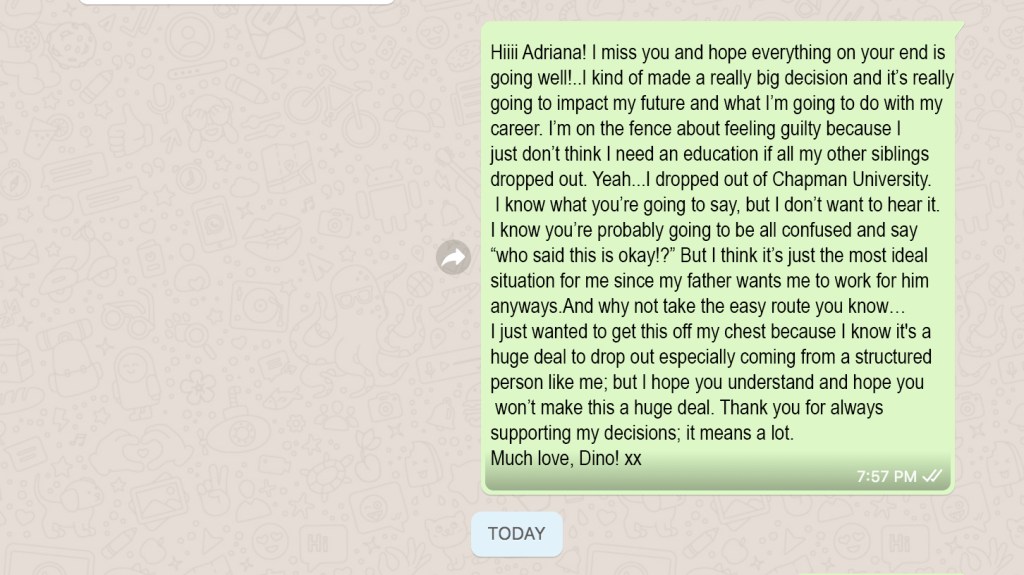
#1 To my Friend Adriana:
#2 To my Parent
Hello Father,
I apologize in advance for what I am about to say. I am writing this letter to you because I have some news. I really hope you can hear me out through this. This is really hard to put into words through this isn’t a normal action I would do. But I am dropping out of college. I hope you can understand, I know I told you I was going to graduate, unlike Areej, Romi, and Nabeel who all dropped out. I’m truly sorry if I am another disappointment. I know you had high expectations for me. I’m so sorry dad. Just know that I have a plan and that I am going to figure this all out.
So please don’t stress and don’t worry about me, I’m going to be fine. I love you Baba.
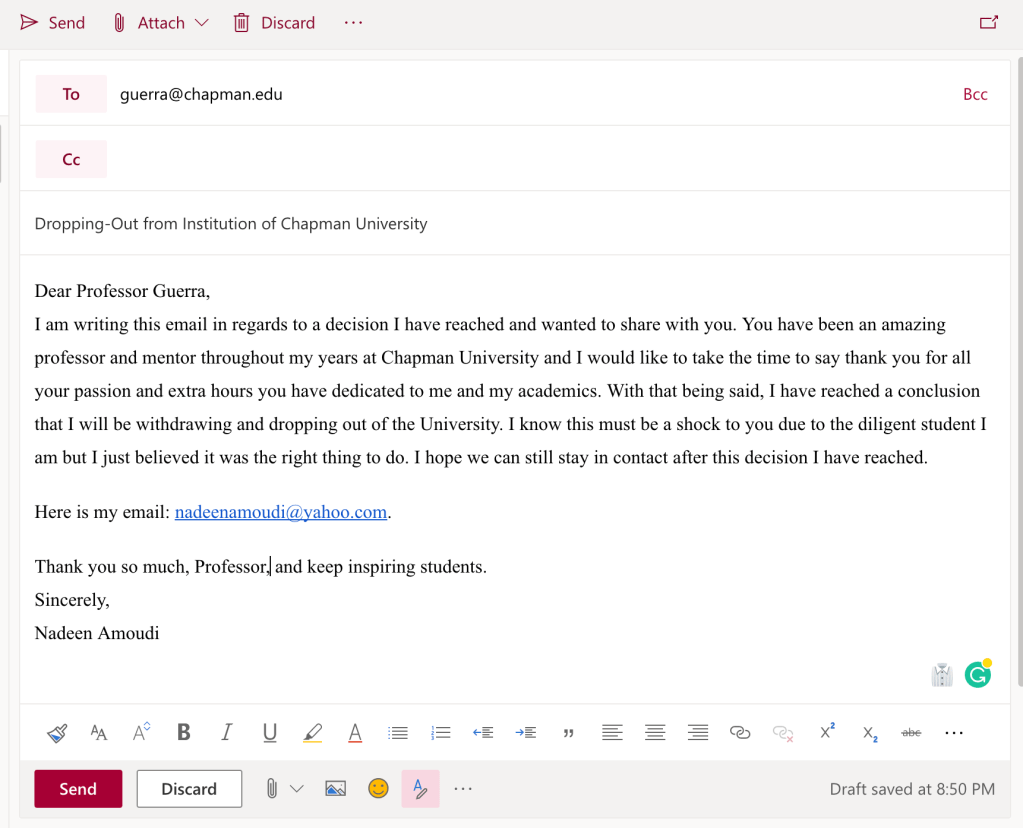
#3 To my Professor/Mentor
This is an example post, originally published as part of Blogging University. Enroll in one of our ten programs, and start your blog right.
You’re going to publish a post today. Don’t worry about how your blog looks. Don’t worry if you haven’t given it a name yet, or you’re feeling overwhelmed. Just click the “New Post” button, and tell us why you’re here.
Why do this?
The post can be short or long, a personal intro to your life or a bloggy mission statement, a manifesto for the future or a simple outline of your the types of things you hope to publish.
To help you get started, here are a few questions:
You’re not locked into any of this; one of the wonderful things about blogs is how they constantly evolve as we learn, grow, and interact with one another — but it’s good to know where and why you started, and articulating your goals may just give you a few other post ideas.
Can’t think how to get started? Just write the first thing that pops into your head. Anne Lamott, author of a book on writing we love, says that you need to give yourself permission to write a “crappy first draft”. Anne makes a great point — just start writing, and worry about editing it later.
When you’re ready to publish, give your post three to five tags that describe your blog’s focus — writing, photography, fiction, parenting, food, cars, movies, sports, whatever. These tags will help others who care about your topics find you in the Reader. Make sure one of the tags is “zerotohero,” so other new bloggers can find you, too.

 Nadeen's Blog